Snowflake GES-C01 Prüfungsthemen:
| Abschnitt | Gewichtung | Ziele |
|---|---|---|
| Architektur und bewährte Verfahren | 10–15 % | - Architekturentwurf von LLM-Verarbeitungsketten - Verfahren zur Leistungsoptimierung - Strategien zur Kostensteuerung - Rahmenkonzepte für Überwachung und Bewertung - Aspekte der Sicherheit und des Datenschutzes |
| Datenaufbereitung für generative KI | 15–20 % | - Verarbeitung unstrukturierter Daten - Dokumentenverarbeitung und Strategien zur Aufteilung in Teilabschnitte - Vektorspeicher und Embeddings in Snowflake - Datenverwaltung für KI-Arbeitslasten |
| Funktionsumfang von Snowflake Cortex AI | 25–30 % | - Sichere Datenverarbeitung in KI-Arbeitsabläufen - Funktionen und Merkmale von Cortex AI - Modellauswahl und Kostenoptimierung - Verwendung und Parameter der Funktion COMPLETE - Integration von Snowflake Copilot |
| Cortex Analyst und semantische Ebene | 20–25 % | - Entwurf und Konfiguration semantischer Modelle - Leistungsoptimierung von Analyseabfragen - Übersetzung von Text in SQL und deren Optimierung - Umsetzung von Geschäftslogik in semantischen Modellen |
| Grundlagen und Konzepte der generativen KI | 20–25 % | - Konzepte der Retrieval-Augmented Generation (RAG) - Grundlagen und Architekturen von LLMs - Vektor-Embeddings und Ähnlichkeitssuche - Grundsätze der Prompt-Entwicklung - Feinabstimmung im Vergleich zu abrufgestützten Verfahren |
Snowflake SnowPro® Specialty: Gen AI Certification GES-C01 Prüfungsfragen mit Lösungen
A developer is building an interactive chat application in Snowflake leveraging the COMPLETE (SNOWFLAKE. CORTEX) LLM function to power multi-turn conversations. To ensure the LLM maintains conversational context and generates coherent responses based on prior interactions, which of the following methods correctly implements the passing of conversation history to the COMPLETE function?
- A. Option C
- B. Option E
- C. Option B
- D. Option D
- E. Option A
Antwort: C 🗳️
Erklärung: (Nur für DeutschPrüfung-Mitglieder sichtbar)
An administrator is reviewing their Snowflake bill and observes higher than expected storage and cloud services compute costs for a newly deployed Cortex Search Service. They need to investigate these charges. Which of the following statements correctly explains how these specific costs are incurred or can be monitored for a Cortex Search Service?
- A. Cloud Services compute costs for Cortex Search are always billed without any adjustments, regardless of the daily virtual warehouse compute costs, because they are considered serverless features.
- B. Storage costs are incurred for both the materialized source query data and the search index data structures, and these costs can be estimated by materializing the source query into a table using the CORTEX_SEARCH_DATA_SCAN table function, and then examining the size of that table.
- C. High cloud services compute costs for Cortex Search are primarily driven by the complexity of the embedding model selected and can be optimized by choosing a simpler model.
- D. The 'CORTEX_DOCUMENT_PROCESSING_USAGE_HISTORY view is the most appropriate tool to monitor Cortex Search storage and cloud services compute costs, as it tracks all ' Services usage.
- E. The 'CORTEX_SEARCH_DAILY_USAGE_HISTORY view provides detailed breakdowns of storage costs per TB and cloud services compute credits incurred, including the 10% daily warehouse cost adjustment.
Antwort: B 🗳️
Erklärung: (Nur für DeutschPrüfung-Mitglieder sichtbar)
A data engineering team wants to deploy a proprietary PyCaret classification model, saved as pycaret_best_model.pkl, for inference within Snowpark Container Services (SPCS). They need to register this custom model in the Snowflake Model Registry. Which of the following is a correct and essential step in this process?
- A. Option C
- B. Option E
- C. Option B
- D. Option D
- E. Option A
Antwort: C 🗳️
Erklärung: (Nur für DeutschPrüfung-Mitglieder sichtbar)
A Gen AI Specialist is tasked with enhancing a Cortex Analyst semantic model to improve the accuracy of literal string searches for product names within user queries. The product names are stored in a high-cardinality PRODUCT_NAME column in the underlying PRODUCT table. The current semantic model already defines a dimension for PRODUCT_NAME. Which of the following configurations and considerations are essential for integrating Cortex Search with Cortex Analyst to achieve this goal?
- A. Option C
- B. Option E
- C. Option B
- D. Option D
- E. Option A
Antwort: C 🗳️
Erklärung: (Nur für DeutschPrüfung-Mitglieder sichtbar)
An ML Engineer has developed a custom PyTorch model for GPU-powered inference and successfully built an OCI-compliant image locally. They now need to push this image to a Snowflake image repository and configure a Snowpark Container Service to use it. The Snowflake account identifier is my org_name_my_account_id_prod. Which set of commands correctly demonstrates tagging the local image and pushing it to the repository?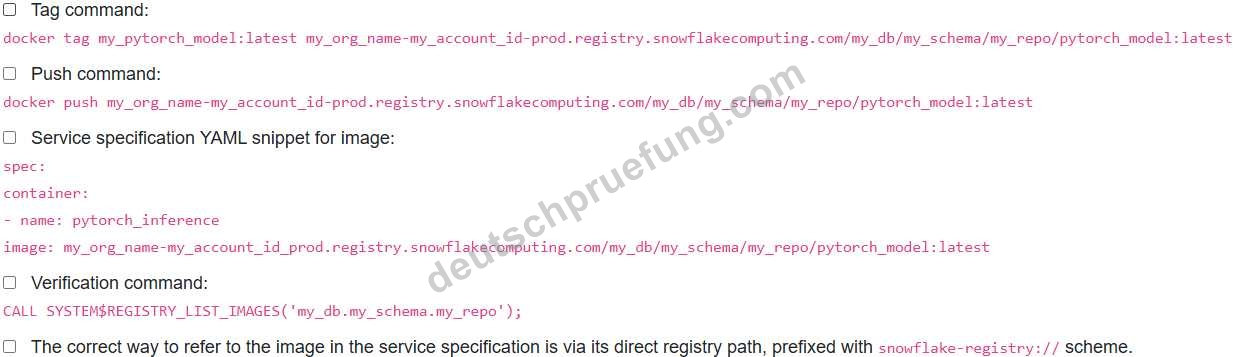
- A. Option C
- B. Option E
- C. Option B
- D. Option D
- E. Option A
Antwort: C,E 🗳️
Erklärung: (Nur für DeutschPrüfung-Mitglieder sichtbar)
Seite 1 von 71 wird angezeigt.
Fragen 1-5 von 351 werden angezeigt.
 1137 Kundenbewertungen