GED GED-Science Prüfungsthemen:
| Abschnitt | Gewichtung | Ziele |
|---|---|---|
| Wissenschaftliche Arbeitsweisen | - Auswerten von Daten, Diagrammen und Tabellen - Anwenden mathematischer Verfahren in den Naturwissenschaften - Planung und Bewertung von Experimenten - Lesen und Verstehen wissenschaftlicher Texte | |
| Biologie | 40% | - Evolution und natürliche Auslese - Aufbau und Funktion von Zellen - Energiefluss in Ökosystemen - Körpersysteme des Menschen und Gesundheit - Genetik und Vererbung |
| Erd- und Weltraumwissenschaften | 20% | - Meere und Süßwassersysteme - Wetter, Klima und Atmosphäre - Sonnensystem und Universum - Natürliche Ressourcen und Nachhaltigkeit - Erdsysteme und geologische Kreisläufe |
| Physik und Chemie | 40% | - Arbeit, Leistung und Wellen - Chemische Reaktionen und Stoffeigenschaften - Aufbau von Atomen und chemischen Verbindungen - Erhaltung von Masse und Energie - Bewegung, Kraft und Energie |
GED Science GED-Science Prüfungsfragen mit Lösungen
The following symbols represent a shortcut for representing an element. For example, O
stands for oxygen, H for hydrogen, and C for carbon. H2O is the formula for water. The subscript 2 in the formula indicates that there are two atoms of hydrogen in a water molecule. If there is no subscript after a symbol, the subscript is assumed to be one. Therefore, one molecule of water contains three atoms: two hydrogen atoms and one oxygen atom.
Based on the information, how many atoms are represented in C12H22O11?
- A. 3
- B. 11
- C. 45
- D. 12
- E. 22
Antwort: C 🗳️
Erklärung: (Nur für DeutschPrüfung-Mitglieder sichtbar)
Examine the following graph.
One wavelength is the distance from one crest of a wave to the next crest or from a trough (low point of a wave) to the next trough. The frequency of a wave is the number of crests that pass any given point each second.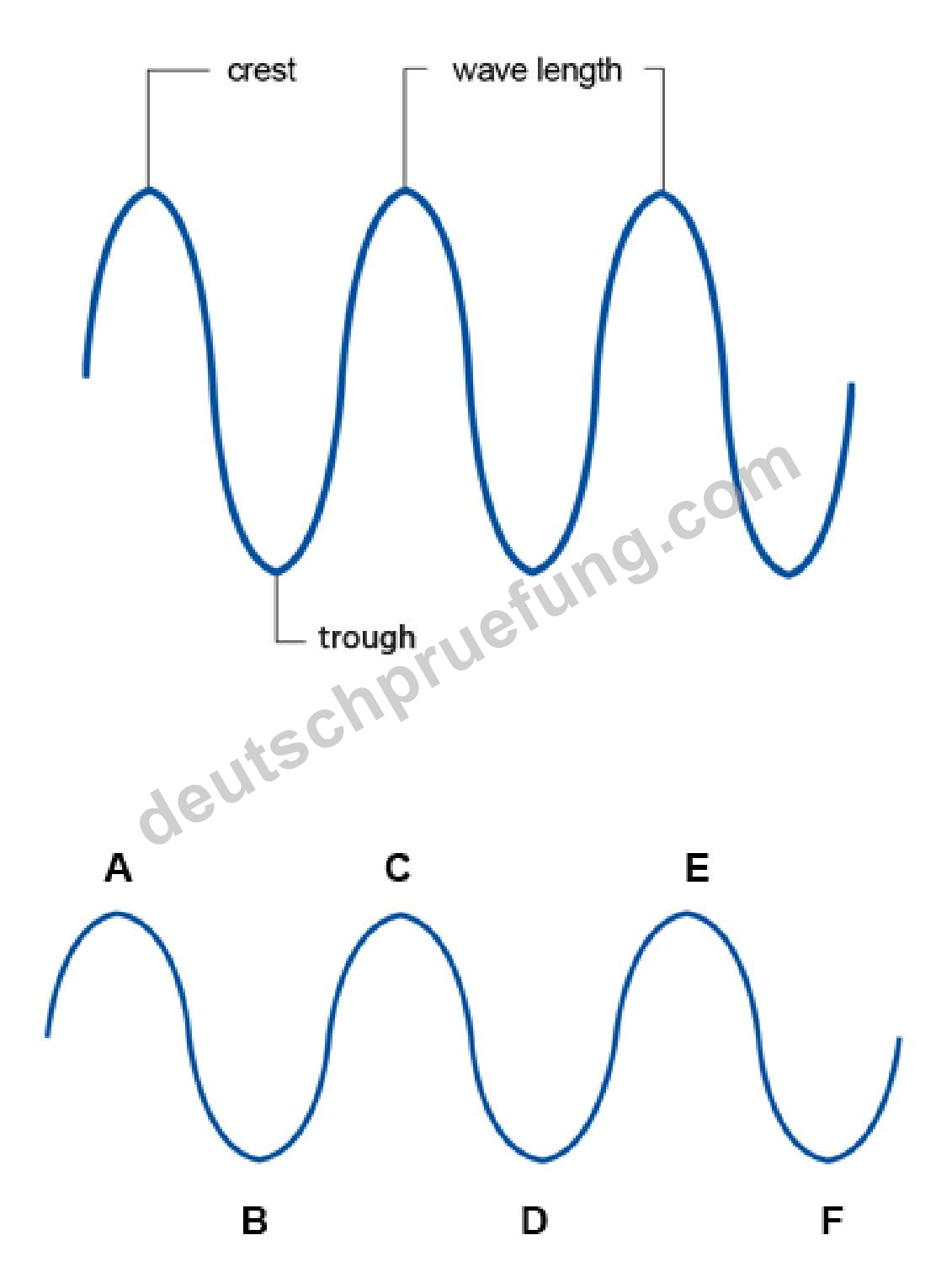
Which section represents one complete wavelength?
- A. D to E
- B. C to F
- C. A to D
- D. A to B
- E. C to E
Antwort: E 🗳️
An object thrown straight up into the air eventually returns to Earth. As the object moves upward, the force of gravity pulls on the object, and its velocity will decrease until it stops. As the object falls back toward Earth, the force of gravity causes its velocity to increase.
At which point in the object's pathway is its velocity at zero?
- A. when the object is halfway up into the air
- B. just before the object returns to Earth
- C. when the object leaves the hand of the person throwing it
- D. when the object is halfway down from its farthest point of ascent
- E. when the object stops ascending and is about to descend
Antwort: E 🗳️
Meteorites are broken fragments formed from comets and by collisions between asteroids orbiting the Sun in the belt between Mars and Jupiter. Meteorites range in size from fine dust particles to bodies many miles in diameter that produce large craters when they strike Earth, Mars, or the Moon.
From what sources do many meteorites originate?
- A. Mars
- B. collisions among solar showers from the stars
- C. fragments of Jupiter's moons
- D. the center of the Sun
- E. asteroids
Antwort: E 🗳️
Anton Van Leeuwenhoek observed living cells using microscopes that he designed and built. His particular passion was working with and perfecting microscope lenses; and he kept all of his techniques secret to prevent other scientists or inventors from stealing his ideas. Leeuwenhoek recorded his microscope observations, which were helpful to later scientists.
Which statement best describes Leeuwenhoek's scientific contribution?
- A. He designed and built early microscopes and used them to observe microscopic organisms.
- B. Most modern knowledge about meteorology and astronomy can be traced to his observations.
- C. He classified thousands of animals and plants.
- D. He influenced the development of modern chemistry.
- E. His work centered on making many types of antibiotics and vaccines.
Antwort: A 🗳️
Seite 1 von 60 wird angezeigt.
Fragen 1-5 von 300 werden angezeigt.
 930 Kundenbewertungen