Databricks Databricks-Machine-Learning-Professional Prüfungsplan:
| Thema | Einzelheiten |
|---|---|
| Thema 1 |
|
| Thema 2 |
|
| Thema 3 |
|
| Thema 4 |
|
| Thema 5 |
|
| Thema 6 |
|
| Thema 7 |
|
| Thema 8 |
|
| Thema 9 |
|
Referenz: https://www.databricks.com/learn/certification/machine-learning-professional
Databricks Certified Machine Learning Professional Databricks-Machine-Learning-Professional Prüfungsfragen mit Lösungen
A data scientist has developed a scikit-learn random forest model model, but they have not yet logged model with MLflow. They have created a model signature model_signature and a few example input records input_records. Which block of code can be used to log all of this information?
- A. There is no way to log a model signature.
- B. mlflow.sklearn.log_model(model, "model")
mlflow.log_signature(model_signature)
mlflow.log_input(input_records) - C.
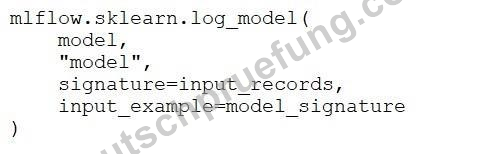
- D.
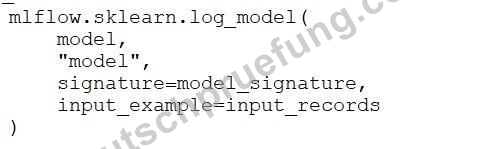
Antwort: D 🗳️
Erklärung: (Nur für DeutschPrüfung-Mitglieder sichtbar)
Which of the following MLflow operations can be used to delete a model from the MLflow Model Registry?
- A. client.delete_registered_model
- B. client.transition_model_version_stage
- C. client.delete_model_version
- D. client.delete_model
- E. client.update_registered_model
Antwort: A 🗳️
A Data Scientist has trained a regression model using Spark's MLlib to predict housing prices.
The model needs to be evaluated to determine how well it predicts on a testing dataset. The Data Scientist wants to use a standard regression metric for the evaluation. They also want to evaluate the model with the least processing overhead required. Which approach will suit their needs?
- A. Use the MLlib's RankingEvaluator with the metricName set to rmse to calculate root mean squared error on the testing dataset.
- B. Use the MLlib's RegressionEvaluator with the metricName set to rmse to calculate root mean squared error on the testing dataset.
- C. Implement a Spark UDF to calculate the root mean squared error for each row in the testing dataset and aggregate these values to obtain the overall RMSE score.
- D. Convert the testing dataset to a pandas DataFrame and use scikit-learn's root_mean_squared_error function to calculate the root mean squared error on the testing dataset.
Antwort: B 🗳️
Erklärung: (Nur für DeutschPrüfung-Mitglieder sichtbar)
A Machine Learning Engineer is conducting hyperparameter tuning for multiple XGBoost models using Ray Tune on Databricks. They want to integrate MLflow tracking to monitor their experiments and need to ensure proper authentication. The engineer has Ray 2.41 installed and wants to use both Ray Tune and MLflow together in their distributed tuning workflow. They have to configure Databricks to run the hyperparameter optimization with MLflow integration. Which set of configuration steps will do this?
- A. Enable MLflow autologging with mlflow.ray.autolog() and set the tracking server URI.
- B. Configure DATABRICKS_HOST and DATABRICKS_TOKEN environment variables before calling setup_ray_cluster().
- C. Set MLFLOW_TRACKING_URI and MLFLOW_EXPERIMENT_TD environment variables before initializing Ray.
- D. Install the MLflow Ray plugin using %pip install mlflow-ray and configure the workspace connection.
Antwort: B 🗳️
Erklärung: (Nur für DeutschPrüfung-Mitglieder sichtbar)
A machine learning engineer is converting a Hyperopt-based hyperparameter tuning process from manual MLflow logging to MLflow Autologging. They notice that not all details and objects are automatically logged, and they will need to manually log some things. Which of the following will need to be manually logged when performing nested runs with Hyperopt and MLflow Autologging?
- A. Best trial evaluation metric
- B. Trial status
- C. Hyperparameter values
- D. Evaluation metrics
- E. Trial models
Antwort: A 🗳️
Erklärung: (Nur für DeutschPrüfung-Mitglieder sichtbar)
Seite 1 von 39 wird angezeigt.
Fragen 1-5 von 193 werden angezeigt.
 1191 Kundenbewertungen